A voice over is a recorded voice you hear without seeing the person speaking. It accompanies a commercial, a corporate film, a documentary, an e-learning module or even a simple telephone message. Its role is to explain, guide, persuade or create an atmosphere, without appearing on screen.
It can make you smile in a twenty-second commercial, hold your attention through a documentary, guide you around a museum or reassure you on the phone. Listen closely and you will find it everywhere: invisible yet essential, connecting a message with its audience.
Since 1991, I have lent my voice to many different worlds: advertising, radio, corporate films and documentaries. In 2004, I set up my professional home studio, enabling me to work remotely with agencies and businesses around the world.
I have worked on slogans that needed to be irresistible, training modules that needed to stay engaging for hours, and corporate films where every word had to sound credible.
In 2025, voice over is exploring new formats, but its role remains the same: creating an immediate human connection.
This guide was designed to give you:
And if you are looking directly for an experienced female voice over artist for your productions, you are in the right place.
1. What is a voice over?
Defining voice over
A voice over is a recorded voice you hear without seeing the person speaking. It accompanies an image, a video, an animation or a telephone message. Its role is to guide, explain, persuade or create an atmosphere. Although invisible on screen, it plays a decisive part in the impact of the message.
To explore the vocabulary and particular features of the profession, see the complete voice over glossary. It offers clear definitions of the technical terms often used in the studio.
How it differs from narration and dubbing
Voice over is often confused with other vocal techniques:
- Narration: it tells a story from within, as in a novel or a podcast.
- Dubbing: it replaces an on-screen actor’s voice, synchronised with their lip movements.
- Voice over: it remains outside the action. It comments, provides structure and connects content with its audience.
My personal definition
I see myself first and foremost as a voice over craftswoman. My career began at a small radio station in the Doubs in 1991. In 2004, I set up my professional home studio. Since then, I have developed my voice as a precision tool for a wide variety of projects.
Being a freelance voice over artist means wearing several hats: artist, independent professional and business owner. It is a choice I made more than twenty years ago, and one that still pushes me to find the right tone for every project.
2. Understanding how voice over is used
The role of a voice over changes with the medium. In advertising, it needs to grab attention in seconds. In a documentary, it becomes the thread running through the story. In e-learning, it patiently supports the learner. Each style has its conventions, constraints and particular intention.
Advertising: catching attention in seconds
In commercial voice over, every second counts. I often receive briefs that feel like timed riddles: “15 seconds to be impactful and memorable, but not aggressive”. Sometimes the difference comes down to an audible smile or a breath in just the right place. It is the art of condensing an emotion into very little time.
Corporate films: inspiring credibility and trust
A corporate film or company video aims to reassure rather than seduce. The voice needs to convey a serious, solid, credible message. I see myself a little as the company’s vocal ambassador: the voice that embodies its values and says, “You can count on us”.
E-learning: sustaining attention over time
An e-learning module can last for hours. An e-learning voice over needs to stay clear, composed and engaging, without becoming tiring. For example, I have recorded highly technical medical training where the challenge was not the precision of the terminology but keeping the listener’s attention. Here, the voice becomes almost an invisible partner, present without being intrusive.
Documentaries: connecting the story and conveying emotion
In a documentary, the voice over is a connecting thread. It sheds light on the images, guides the viewer and conveys the right emotion. It is a style I particularly enjoy: adding a voice to images that are already powerful. A director once told me, “Listening to you gave me goosebumps”. That is when the voice is exactly where it belongs.
Motion graphics: following the visual rhythm
A motion graphics voice over follows the rhythm of the animation. Each inflection becomes a dance step with the graphics. A word stressed at just the right moment, a precisely timed silence: it is all about synchronisation. It is a balancing act in which the voice needs to breathe with the image.
Telephone greetings: a brand’s first impression
A telephone voice over is often the first contact between a business and its customer. A simple message can reassure… or put someone off. I always keep one simple rule in mind: a telephone greeting should be clear, warm and professional. A few poorly delivered words can undermine a company’s entire image.
To explore further: discover the voice over specialities and how each style influences a project’s result.
3. Finding the right intention
The same script can reassure, persuade, move someone… or lose its impact altogether. It all depends on the vocal intention you choose. This is one of professional voice over’s great strengths: finding the exact tone that brings out the message.
When the brief becomes a riddle
Some briefs sound like riddles: “We want a promo voice, but not an advertising voice”, “energetic but composed”, or even “a cloudy voice”. These poetic phrases often express an emotion the client feels but cannot quite name. My role is to turn these images into a clear, effective performance.
Turning poetry into technique
- “Promo, but not advertising” → energy without aggression.
- “Energetic but composed” → pace with a sense of calm.
- “A cloudy voice” → a soft, enveloping, almost misty colour.
Behind these metaphors are very concrete choices: pace, intensity, smile and delivery into the microphone. What seems intangible becomes measurable after years spent exploring different vocal styles.
From my first sessions to today
I still remember my first studio session in 1991. Jean-Paul Caminada and I were recording an on-hold message for the Thermes de Vittel. I spent more than fifteen minutes on a single word: “bonjour”. That search for nuance taught me patience and precision. Thousands of hours at the microphone later, I have refined that approach: today, it is often possible to find the right tone in the first few takes.
The weight of an intention
A vocal intention is never trivial. In advertising, a word can trigger a purchase. In e-learning, a monotonous tone can lose the learner’s attention. In a corporate film, too much warmth can make the message less credible. Finding the right intention gives the message the reach it deserves, without weighing it down or weakening it.
For a closer look at vocal nuances and styles, see my page on voice over intentions.
4. The directed session: approving what you hear
A directed voice over session is a key stage in production: the client, agency or director follows the recording live, and each intention can be adjusted on the spot. It ensures the result sounds right and is approved by ear, with no surprises on delivery.
When several people shape the voice
During a directed session, we create the performance together. The creative director guides the performance, the sound engineer oversees the technical side, and the communications team or client approves the nuances live. It is not unusual to have more than ten people connected to the same session.
A connected home studio
My professional home studio makes remote collaboration easy. With tools such as Source Connect, Source Nexus, SessionLinkPRO, IPDTL and Cleanfeed, I can work live with agencies and studios internationally while ensuring broadcast quality.
Saving time and providing peace of mind
For clients, a directed session provides reassurance: we find the right tone straight away, without endless back-and-forth. The project moves quickly, everyone leaves with an approved version, and final delivery becomes a straightforward formality. It is a demanding but valuable process in which technical precision meets artistic standards.
To find out more, see my page on directed voice over sessions.
5. Voice over trends in 2025
The voice over profession is changing fast. There are more media, shorter formats and technologies that disrupt familiar ways of working. As a professional voice over artist for more than twenty years, I have seen these changes unfold, and certain trends are now taking hold in 2025.
The rapid rise of audiobooks
Audiobooks are one avenue for narration. Performing a long text requires stamina, controlled pacing and a consistent performance.
Performing an audiobook means maintaining a steady rhythm over hundreds of pages and sustaining the narrative atmosphere. It is a demanding speciality that requires stamina and precision.
E-learning: an essential part of the picture
E-learning uses the voice to support learners, clarify concepts and sustain attention over time.
Every training module needs a clear, steady and engaging voice over. Imprecise diction or a monotonous tone can lose the learner’s attention. Here, the voice becomes a true partner in learning.
Artificial intelligence: another reality
Synthetic voices are part of production practice. The choice depends on the project, the available rights and the performance required.
But let us be clear: AI reproduces sounds; it does not build a relationship. My work as a voice over artist is based on performance, adaptation and human collaboration. It is this relationship that clients are looking for and that, in 2025, remains irreplaceable.
Personalisation and multiple formats
A single advertising campaign now comes in 10 versions: TV, social media, vertical mobile formats, digital pre-rolls… A commercial voice over needs to be flexible and responsive, adapting its intention to each version while staying consistent.
Integrated multilingual production
Multilingual productions require coordination between performers, versions and delivery requirements.
Coordinating several voice actors then becomes a skill in its own right.
Short and mobile formats
Short mobile formats call for concise messages and a pace suited to each medium.
Audio branding and vocal identity
A recurring voice can become part of a brand’s sonic identity when productions and rights are planned over time.
Blending performance styles
The boundaries between advertising, podcasts, documentaries and corporate content are becoming less distinct. I am sometimes asked for a “podcast” tone in an e-learning module, or a “documentary” style for a corporate video. In 2025, the key is versatility and command of different vocal styles.
Voice over has never been so present. In 2025, its world is changing fast, driven by technology, new uses and increasingly specific client expectations. These are the major trends reshaping the profession.
6. Rates, formats and usage rights
More than a recording
A voice over rate covers more than time at the microphone. It includes preparation, performance, technical work and the assurance of a professional result. Added to this are usage rights, which define where, how and for how long the voice will be used. For an overview, see the basics of voice over rates (in French).
What affects the price
- the project’s duration and the script’s complexity;
- the number of versions (short formats, vertical formats and social media adaptations);
- the languages recorded;
- the territory of use (France, Europe or international);
- the media involved (TV, radio, web/paid social, cinema, in-store or telephony).
- the voice actor’s reputation and experience, which save time and therefore money
Market references and the legal framework: transparency
The quote specifies the service, deliverables, rights and remuneration arrangements. Article L. 7121-3 of the French Labour Code provides for a presumption of an employment contract when a performing artist is engaged for payment, subject to the conditions it sets out. The applicable framework must be checked for the service concerned.
As international reference points (not binding in France), the GVAA Rate Guide and SAG-AFTRA Voiceover Contracts offer indicative rates and union minimums applicable in the United States.
Reference rates and the quote
I use reference rates adapted to the specifics of each project. The simplest approach is often to prepare a clear quote after a precise brief covering duration, media, territories and the term of the rights. → Preparing a voice over quote.
Formats and deliverables
I deliver broadcast-ready files (by default WAV 48 kHz / 24 bit, with other formats on request), clearly named and ready to mix. My technical setup is detailed here: voice over home studio.
What a quote covers: a recap
| Item | What it covers | Effect on the price |
|---|---|---|
| Session | Recording, performance and recording engineering | Depends on duration, complexity and direction |
| Usage rights | Media, territories and duration of use | Increases with exposure (TV/radio/web…) |
| Versions | Adaptations (6s/10s/15s, vertical formats, languages) | Depends on the number of deliverables |
| Retakes | Corrections included in line with the brief | Specified in the quote and its conditions |
Working on a project or need something urgently? Request a quote
7. Working with a voice over artist: a 5-step process
Working with a professional voice over artist means more than pressing “record” in a studio. It is a clear, structured process that reassures the client and helps the project run smoothly.
1. The brief: laying solid foundations
A precise brief is already half the work. The objective, audience, intended tone, media and usage rights: the clearer the guidance, the faster the voice will find the right style.
2. Preparing the script
A script written for speech works better aloud than one written only to be read. Short sentences, clear points of emphasis and planned adaptations, such as a short version for social media or a vertical mobile format. These adjustments avoid unnecessary retakes and save valuable time.
3. Recording
In a broadcast-ready home studio or an external studio, every project benefits from a carefully controlled audio chain. I often record two useful variations, one restrained and the other more expressive, to give the client real flexibility in the edit.
4. Editing and checking the files
A raw recording is not enough. Every file goes through careful editing: cleaning up breaths, balancing levels and checking it in full from beginning to end. The result is files your technical team can use straight away.
5. Delivery and archiving
A clear quote also includes delivery and archiving. Every project is organised, dated and exported in the right format (WAV, MP3, 48 kHz). This recordkeeping ensures that a file can be found years later, identical to the version delivered.
To sum up: working with a voice over artist means following a clearly defined process, with no grey areas. This approach keeps things smooth and reassuring and, above all, produces a result faithful to your original intention.
8. How do you become a voice over artist?
Before discussing training or technique, we need to talk about resilience. This profession is an emotional rollercoaster: real highs when you win a great campaign or a client places their trust in you, and real lows when auditions follow one another without a response or the workload fluctuates. Experience does not make this disappear: even after twenty years in the profession, I still ride those ups and downs.
The key is to accept that pattern, stay on course and keep improving. Behind the adrenaline and uncertainty is a fascinating, demanding profession, full of life.
Training and practice
You learn to support your voice, manage your breath and articulate… but above all to perform a script. Reading is not enough: you need to convey an intention. To understand the profession’s technical terms, see the voice over glossary, which explains each key concept. Then comes practice: daily training remains essential. When an outside perspective would help, individual voice over coaching (in French) can identify what is holding you back and what needs attention first.
Demos: the actor’s calling card
Even before landing your first job, you need to record demos. They let clients hear different intentions, vocal approaches and styles. They are your audio showcase, much like a photographer’s portfolio.
My own journey
For me, it all began at a small independent radio station in the Doubs. It was hands-on and sometimes makeshift, but I learnt to feel at home with the microphone. A few years later, I made a decisive choice: setting up a professional home studio in 2004. At the time, that was still unusual. This technical freedom let me work with clients all over the world while remaining independent.
Independence: a demanding choice
Becoming an online voice over artist also means choosing a way of life. You become both an artist and an entrepreneur. For freelancers, that means taking on the role of business owner:
- taking care of your client service,
- handling quote requests and urgent jobs,
- being your own bookkeeper,
- doing your own business development,
- and sometimes even being your own studio technician.
It is less about counting your hours than taking on several jobs in one.
The economic reality
In 2025, let us be clear: very few beginners manage to generate regular turnover. It often takes three to five years, giving it 300%, to reach a stable income. It is a marathon, not a sprint.
The 2025 survey by NAVA (the National Association of Voice Actors) offers a snapshot of the international profession:
- 47% of respondents report annual voice over turnover below $10,000 (no income, small jobs or supplementary work).
- 58% earn less than $25,000 a year.
- At the other end of the scale, around 15% exceed $100,000 a year and share a substantial part of the market.
It is essential to remember that these figures are turnover, not take-home pay: social contributions, equipment, communications, training and tax still have to be deducted. In other words, making a living solely from voice over remains a challenge, and the early years are often precarious.
For the steps involved and practical advice, I have written a full page on becoming a voice over artist.
 Estelle Hubert
9. The key skills in voice over
People sometimes think a “nice voice” is enough. In reality, it accounts for less than ten per cent of the job. The rest is technique, precision and the ability to put your breath and energy at the service of a script.
Acting and performance
A voice over is never neutral. Even a simple safety instruction needs the right balance.
- Finding the right intention
- Adjusting the tone without overdoing it
- Keeping the performance consistent from beginning to end
→ To explore different vocal colours, take a look at the page on voice over intentions.
Breathing and diction
Air is the raw material. Without control of breath and articulation, the message loses clarity.
- Breathing in the right places to maintain the rhythm
- Supporting the voice for a more comfortable listening experience
- Articulating without heaviness for clear narration
→ A mispronounced word or imprecise articulation can change the meaning of a script. To clarify each technical term, I have created a voice over glossary for production teams and actors alike.
Adapting to the brief
Every project has its own conventions. The voice over artist’s role is to understand and embody them.
- A commercial needs to catch attention immediately
- E-learning needs to stay fluent and engaging over time
- A corporate film needs to inspire trust
→ To help with this stage, I offer a ready-to-use corporate voice over brief.
Responsiveness and stamina
This is a profession in which you might record three commercials in the morning, a documentary in the afternoon and an e-learning module in the evening.
- Delivering quickly without sacrificing quality
- Preserving your energy across several sessions
Experience of directed studio sessions
Even the best voice gains nuance when it is directed.
- Adjusting in real time
- Quickly offering several alternatives
- Listening, trying again and refining
→ To understand this approach, discover the directed voice over session.
The people around you: the unseen driving force
Building a support network is both an artistic and a strategic skill.
- The right coaches: those who help you improve, not those who sell formulas
- Personal support: people close to you who believe in the project
- In my own career, my HUSBAND, my personal and professional partner Stéphane Hubert, played a key role: handling administration, building my booth, putting his career on hold to develop mine and looking after our 3 children.
The ability to work alone
You also need to be able to sustain your work on your own.
- Recording for hours in your booth
- Wearing several hats: business development, bookkeeping and communications
Vocal health and care
A professional voice over is as much a working instrument as a skill. Looking after it helps ensure consistency and quality for every project. If vocal fatigue does set in, see my page on voice loss in voice over: recovery and prevention for guidance.
10. Equipment and the studio
A good microphone does not make a good actor. But poor equipment can ruin the finest performance. In this profession, the studio is an extension of the voice. It needs careful planning and a coherent setup. There is little point in buying a €5,000 recording booth if you are working with a €300 microphone. Nor do you need a Neumann U87 if your audio interface costs €100 and your cables €20. A recording studio is a complete signal chain.
The microphone and the booth
A good-quality microphone, an acoustically treated booth and a quiet room: these are the foundations of a recording that can go straight into production. Without them, even the best performance lacks credibility.
Interfaces and the audio chain
A reliable preamp, a high-end audio interface and a properly configured workstation: every link matters. This is about a coherent signal chain, rather than chasing fashionable equipment. Buying the microphone everyone is talking about or the latest star interface achieves little unless the whole setup is designed as a system.
Connecting directly
Today, remote direction has become the norm. Source Connect, SessionLinkPRO and Cleanfeed allow live collaboration with studios and agencies around the world. They save time and help maintain a consistent artistic direction.
Consistent sound
A studio also promises that every project will have the same sound quality, whether it is a 10-second commercial or an e-learning series of 30 modules. Clients know they will receive a file ready to use, without unpleasant surprises.
Equipment chosen for voice over
In my studio, every element was chosen for fidelity and consistent sound. Here is my signal chain:
- A soundproofed, isolated booth with Vicoustic acoustic treatment to keep the room quiet and absorb resonances.
- A Neumann U87 microphone to capture the nuances and warmth of a voice.
- A Manley VoxBox valve channel strip, combining a preamp, compressor and equaliser.
- An RME Fireface UC audio interface for faithful digital conversion.
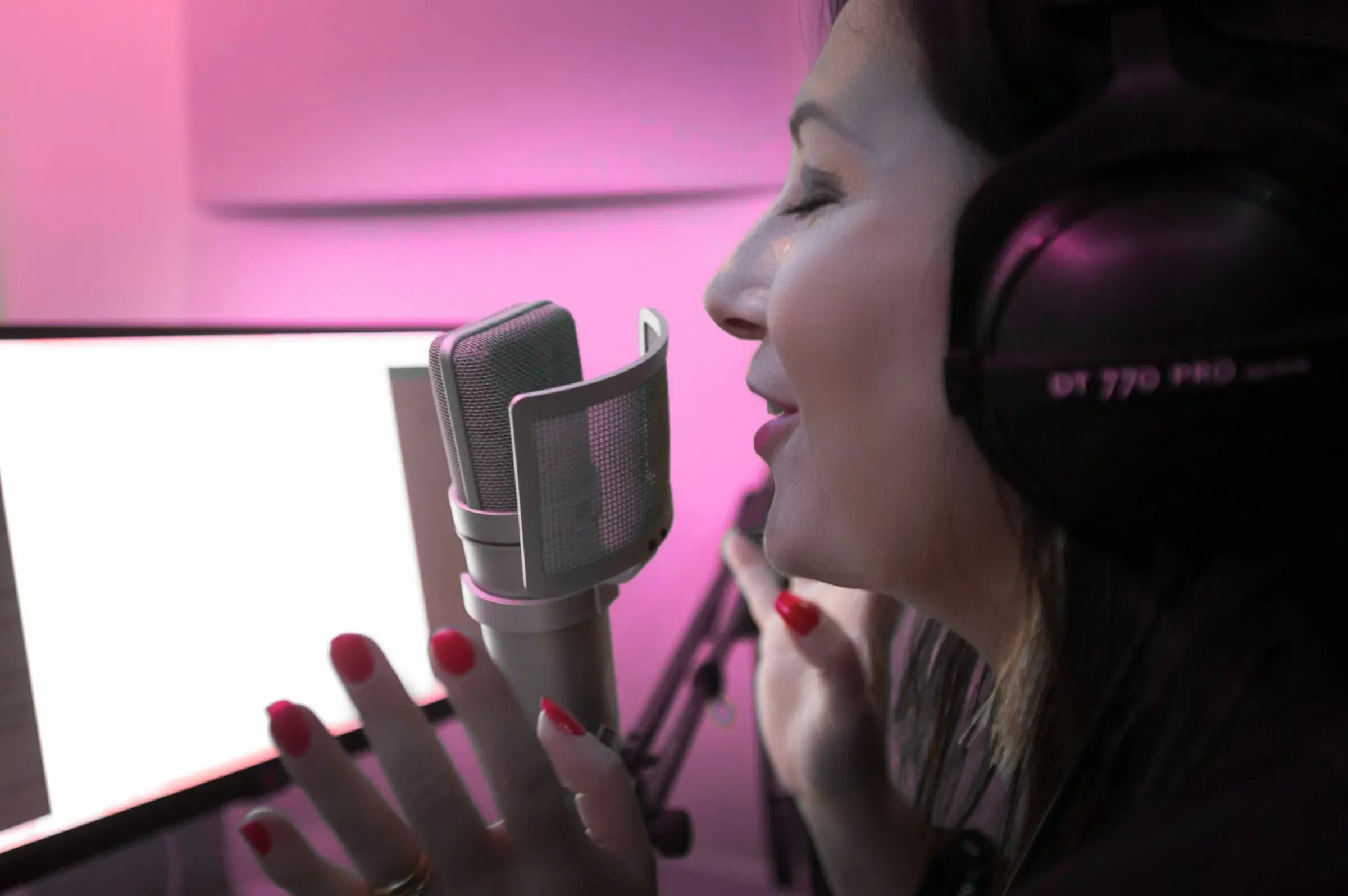
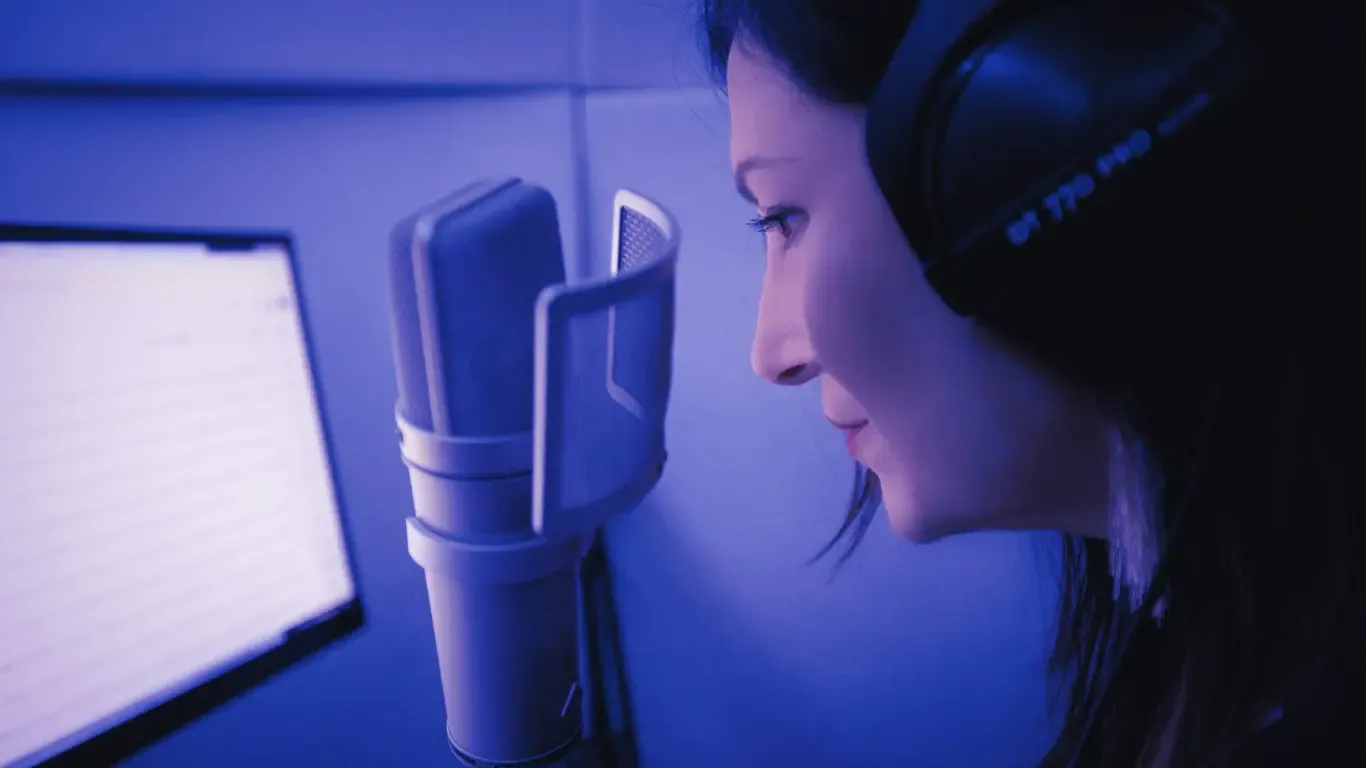
- Beyerdynamic DT 770 Pro headphones for precise monitoring in real time.
- Pro Tools and Sound Forge software
This is not a race to buy the most expensive equipment. It is a coherent signal chain, designed as a system so that every link serves the client's message.
“ In 2020, during the pandemic, home studios sprang up everywhere. Setups appeared overnight, with consumer microphones and entry-level headphones. Everyone could finally say, ‘I work from a home studio’, but few could guarantee broadcast-quality sound. Being a voice actor with a professional studio is a profession in its own right, requiring just as much technical discipline as artistic skill.”
Estelle Hubert11. Frequently asked questions about voice over in 2025
How much does voice over cost in 2025?
The price depends on the type of project (advertising, corporate, e-learning, documentary and more) and the usage rights (local, national or international, for a limited or unlimited term). For more detail, see the voice over rates page.
What is the difference between voice over and dubbing?
Voice over accompanies content without the speaker appearing on screen: advertising, documentaries, e-learning, corporate films and more. Dubbing replaces an on-screen actor's voice with a performance in another language.
Why choose a female voice over?
The choice depends on the intention, audience, medium and acting qualities you need. A female voice can perform in many different styles; an audition using your script lets you judge what suits your project.
How do you become a voice actor today?
Becoming a voice actor takes training, demos and a real entrepreneurial mindset. It is a gradual process that requires several years of investment. A full guide is available here: how to become a voice actor.
Can AI replace a voice actor?
AI can generate synthetic voices. But it does not reproduce the intention, emotion or human relationship that a voice actor builds with a script. That difference is what gives this craft its value.
What equipment does a professional voice actor use?
A professional home studio includes a large-diaphragm condenser microphone, an acoustically treated booth, an audio interface, monitoring headphones and production software that meets broadcast standards. This equipment delivers clear, precise sound that is ready to use.
Writing this guide already says a great deal, but there is always more to share. In more than twenty years behind a microphone, I have seen the profession change, become more professional, embrace new formats and sometimes get caught up in misconceptions. Through it all, every project remains unique: a script, an intention, a client and a story to tell.
I could talk about it for much longer, and I do every day with my clients, partners, colleagues and students. Voice over is a demanding profession, a craft, and a commitment renewed with every take.
If you would like to work with an experienced, responsive and passionate female voice actor, I would be delighted to talk. I have much more to share than can fit on this page, and it all starts with a conversation.
To hear the diversity of this profession, listen to Pierre-Alain de Garrigues, the man of 45,000 voices, whose work spans advertising, narration and video games.
AI voice cloning has become a concrete risk in our profession. I have experienced it personally and explain how to respond in my article: how to get an AI-cloned voice removed.