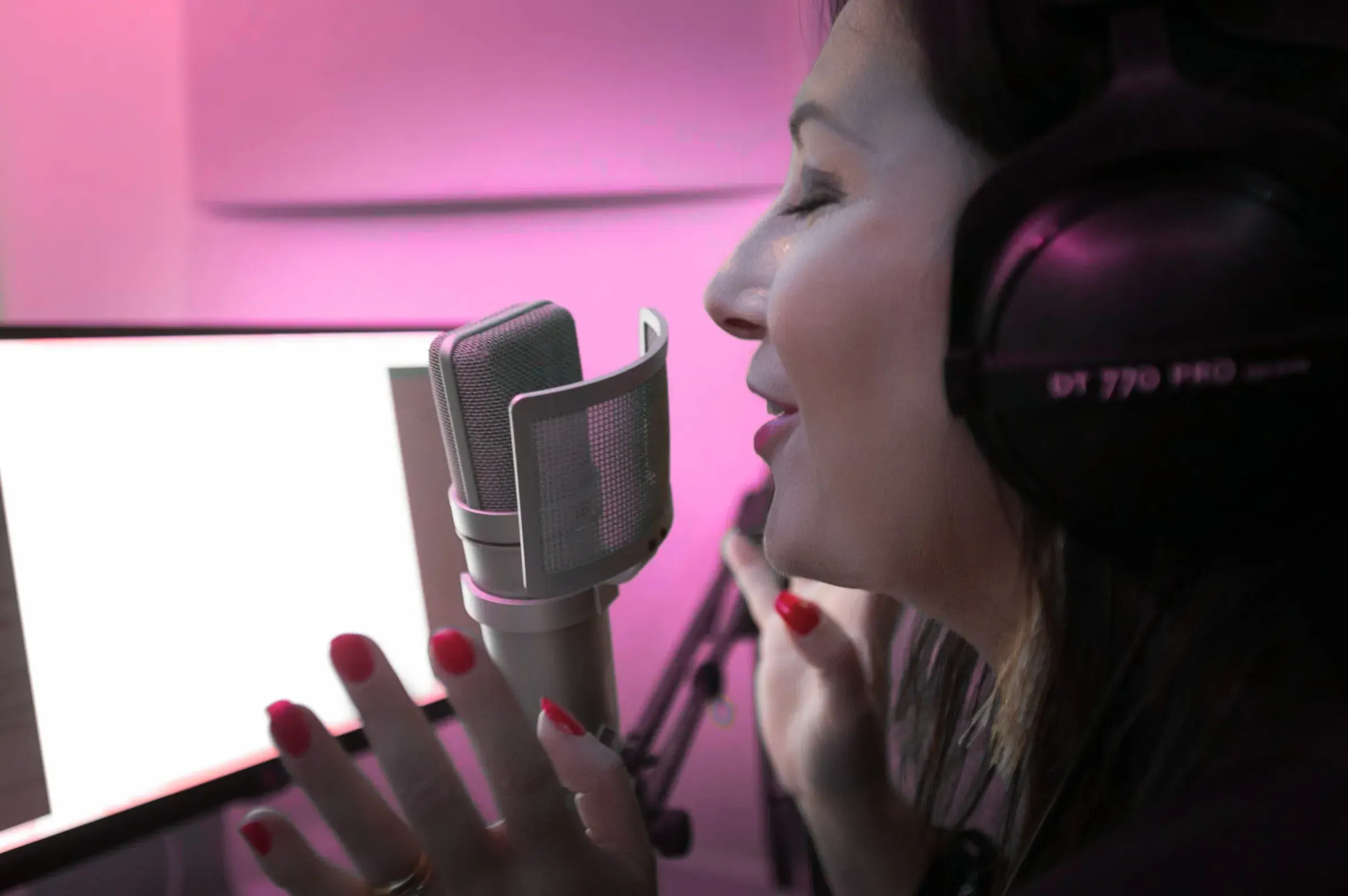

Before I switch on the microphone, let's take a moment. A French female voice over that makes an impression starts with a script, an intention and a clear brief. For a corporate film, the brief brings the voice, tone and rhythm into line with your brand. It connects what you want to say with what your audience will hear.
This guide takes you through the process, using the questions I ask before a recording, examples from my projects and a template you can copy. It also covers motion design and documentaries, with a section on what changes for those formats.
Why does a voice over brief make such a difference?
Before we discuss microphones, tone or file formats, there is a simple question: what will you tell the voice actor to guide the performance? The brief connects your brand's world with the interpretation. It sets out the film's objective, audience, mood, sensitive words and pace: the details that help a voice find its place in your film.
The same film, two briefs
What I can do with it Before I can quote, I have five questions: who is the film speaking to, what should it say, what tone do you want, where will it run and which files do you need?
What I can do with it I can send you a quote and, if you would like, a free audition on an excerpt. That leaves us free to concentrate on the nuances during the session.
A good brief does not need to be technical. It needs to be clear. A few precise lines are more useful than a long document that leaves the important questions open.
What your corporate voice over brief needs to include
A good brief establishes direction, expectations and tone. It gives us a clear starting point for working together. These are the eight elements I look at first.
My brief includes
0 of 8
Tick the information your brief already provides.
Ready? Send it to me, or put it together in a few minutes with the express brief.
1. The video's objective
What should your film do? Introduce the company, explain a strategic project, attract new colleagues, showcase expertise or present a social responsibility initiative? Each objective calls for a different approach to the read. State it in one sentence, including what you want people to remember at the end. That becomes the anchor for the performance.
2. Your audience
Who is the voice speaking to? An investor and an employee listen differently; a business customer and a visitor may expect different tones. For an internal audience, the voice can feel more familiar. With partners, institutions or the general public, a more measured, sometimes more formal delivery may suit the message.
3. The type of corporate video
A company introduction, employer branding, social responsibility, a product presentation, brand film, regional promotion or event film: each format has its own pace, storytelling and expectations. The six main families and examples appear below. For motion design or a documentary, see what changes.
4. The tone you want from the voice
The voice should feel specific to your project. Give me an overall intention, such as measured, conversational or inspiring, an energy level and a reference voice if you have one. If I need to match a version in another language, include that original too. The table of vocal intentions can help you find the words.
5. Duration, pace and timecode
The film's running time and the length of the voice over are often confused. The script's word count is the more useful starting point. Allow no more than 150 words per minute for a natural pace that is comfortable to listen to.
- 30 sec75 words
- 1 min150 words
- 1 min 30 sec225 words
- 2 min300 words
- 3 min450 words
- 5 min750 words
If the voice needs to fit an existing edit, tell me what it must follow: a timecode, a music track or a version in another language.
Allow room for French: as a rough guide, a French version can contain around 20% more words than an English script. Adapting the translation is usually more effective than rushing the read.
 Estelle Hubert
6. References, mood and sound
A selected music track, storyboard, rough cut, reference film, a voice you like or an original script to adapt: anything that helps me enter your film's world also helps me find its rhythm and emotion.
7. The final recording script
Before the session, send the proofread, approved version in Word or PDF. A clear script written to be spoken is more useful than slides or text pasted into an email. A few things help:
- Short sentences, each with a clear thought.
- Punctuation that gives the delivery room to breathe and flow.
- Notes to guide the intention.
- Pronunciation guidance for acronyms, names and technical terms.
The more naturally your script reads, the more naturally the recording will flow.
8. Deliverables and deadline
Specify the format, whether WAV, MP3 or another format, how the files should be prepared, whether raw for your post-production or ready to use, the number of versions and your delivery date. I work to your technical requirements and schedule.
A template to copy
Film: corporate, motion design, documentary, brand film…
Objective: what the film should do and the message to remember at the end
Audience: who the voice is speaking to
Tone: two or three intentions, such as measured, warm or energetic; a reference voice if you have one
Film duration:
Script word count:
Voice and picture: the edit follows the voice, or the voice follows an existing edit, music or another language version
Pronunciation: acronyms, names and technical terms
References: music, rough cut, reference film
Usage: internal, web, TV, events, cinema
Files: raw for post-production or ready to use; file format
Session: I would like you to record independently, or I would like to direct the session
Delivery date:
An imperfect brief is still useful
You do not need twelve pages of specifications. A few clear lines already save valuable time. If some points are still uncertain, I am here to help work them out. We refine the brief together, giving the voice a clear place to start.
Choosing the tone for your corporate voice over
It can be difficult to describe a sound in words. Start with examples: listen to my French female corporate voice over demos and find a reference that feels close to your brand.
Why tone matters as much as the script
The same sentence, delivered in a measured, warm or energetic way, evokes different emotions and responses. That is vocal intention: tone, rhythm, energy and acting choices, adjusted to serve a specific objective.
A vocal intention gives the performance a direction
Intention guides the read, helping the voice express the meaning of the message and connect with your audience. These ten intentions often appear in corporate films, with three shades of each to help you be more precise.
Vocal intentions for corporate videos
| Style | Shade 1 | Shade 2 | Shade 3 |
|---|---|---|---|
| Measured | Clear | Soothing | Nuanced |
| Warm | Smiling | Conversational | Mischievous |
| Inspiring | Gentle | Precise | Emotional |
| Energetic | Playful | Rhythmic | Energetic |
| Corporate | Controlled | Serious | Committed |
| Narrative | Storytelling | Lively | Intimate |
| Explanatory | Accessible | Explanatory | Fun |
| Corporate promotion | Persuasive | Impactful | Sparkling |
| Reassuring | Gentle | Caring | Empathetic |
| Creative | Offbeat | Original | Inspired |
Select an underlined intention to hear its demos.
Explore the full range, with a demo for each shade of delivery, in the dictionary of vocal intentions.
How do you use it in a brief?
The table is a starting point for making a considered, precise choice. A few words in your brief can be enough:
“Energetic, fairly cheerful, but not too promotional” or “Warm and conversational, almost mischievous”.
Estelle HubertStill choosing between several intentions? If your direction is precise, I follow it. If you are still looking for the tone, I can let you hear a few approaches, warmer, livelier or more measured, and we choose together what serves your message.
What are the different types of corporate video?
Corporate video covers very different worlds. You would not address an investor in the same way as a new colleague, and an event teaser needs a different energy from a measured company presentation. These are the six families I encounter most often, each with examples to listen to.
Company introduction / corporate film
This format presents the company's identity, values, work and history, on its website, at a trade show, in a client meeting or to investors. The voice gives the message a steady foundation: setting the pace, making the meaning clear and guiding the viewer's attention.
- Objective
- Establish a clear identity, a confident message and a position in the market
- Audience
- Customers, partners, investors and prospective colleagues
- Tone
- MeasuredClearProfessional
What to specify in the brief
- What should people remember at the end?
- Should the emphasis be on innovation, expertise or company culture?
- A restrained tone, or a more engaging performance?
Listen to examples
Keep in mind Neutrality is not a requirement. A corporate film benefits from finding the balance between precision and carefully judged emotion.
Employer branding / HR video
People are at the centre of recruitment, internal communication and company culture. The voice becomes a companion to the story, supporting it without taking over and bringing out its human side without forcing the emotion.
- Objective
- Reflect the company's character, strengthen a sense of belonging and encourage people to join
- Audience
- Candidates, emerging talent and employees
- Tone
- WarmNaturalSmiling
What to specify in the brief
- Which HR message matters: commitments, wellbeing, values or career mobility?
- A start-up feel, or a more formal corporate tone?
- Does the voice accompany personal testimony, team footage or a narrative?
Listen to examples
- Workday company video voice overFlowing, smiling narration that keeps the focus on people without overplaying it
What to avoid A voice that feels too detached or too promotional can get in the way. Sincerity matters here, and people can hear it.
Social responsibility, values and company culture
When a brand speaks about its impact and commitments, it is sharing what it stands for. The voice carries that conviction, gives the words space and supports the emotion without adding more than the story needs.
- Objective
- Express an ethical position, build trust and bring people together around shared values
- Audience
- Customers concerned with ethics, partners, investors, employees and the media
- Tone
- AuthenticRestrainedEngaged
What to specify in the brief
- Is the message delivered by the founders or by an outside voice?
- How much room should there be for emotion?
- Is the commitment about a product, or about the company's wider role?
Listen to examples
- Latexbio corporate voice overMeasured and empathetic, for a personal, sincere story
- Stanley corporate video voice overClear, restrained and confident, supporting a responsible approach to safety
Keep in mind The depth of the message calls for a controlled, flowing, human delivery. Sincerity comes through in how the voice handles it.
Products, innovation and specialist expertise
Presenting a technical product, expertise or innovation means going beyond the specification sheet. The voice guides the listener, gives the information structure and makes complex material easier to follow, with energy that supports both precision and performance.
- Objective
- Explain a product, technology or process and strengthen the brand's credibility
- Audience
- Business customers, industrial prospects, technical decision-makers and specialist buyers
- Tone
- ConfidentRhythmicExpert
What to specify in the brief
- How much of the story is told by the voice and how much by the images?
- Do any technical terms need explaining?
- Should the tone suggest efficiency, performance, people or practical experience?
Listen to examples
- Scania grain transport trucks video voice overMeasured and gentle, grounded in the practical demands of the work
- NIBE French female corporate voice overRestrained and confident, supporting a responsible technology story
What to avoid Too much salesmanship or technical distance can lose the listener. The voice helps connect performance with trust.
Events, teasers and launch videos
Short, rhythmic and memorable, a launch film introduces a project, product or destination. Every word counts, and the script suggests more than it describes. The voice creates the impulse that makes people want to know more.
- Objective
- Catch attention, create an immediate connection and spark interest
- Audience
- Customers, press, influencers, partners or the general public, depending on the project
- Tone
- EnergeticEnergeticExpressive
What to specify in the brief
- Should the delivery build towards a crescendo?
- Is the voice present from the start, or does it enter at a key moment?
- What kind of music: epic, gentle or electronic?
Listen to examples
- Adobe technology launch video voice overProfessional, energetic and precise, setting the pace of the message
- Arras city teaser voice over, with emotion and a sense of closenessTender, inspiring, almost cinematic
Keep in mind Here, the voice builds anticipation. Alongside the information, it draws people into the story and makes them want to see what comes next.
Brand film / branded content
A company's voice beyond its products: an editorial, narrative or immersive film that tells the story of a mission, vision or commitment, whether corporate, social, regional or charitable.
- Objective
- Express what makes the brand distinctive, give its values a voice and build trust
- Audience
- Customers, employees, institutional partners, local authorities and regional organisations
- Tone
- RestrainedWarmSincere
What to specify in the brief
- Is the film rooted in a particular place or social context?
- Which value leads the story: solidarity, performance, commitment or innovation?
- Is the voice continuous or occasional, personal or neutral?
Listen to examples
- French female corporate voice over for Fondation Père FavronGentle, human and measured, for a film about support for family carers
- SDH motion design voice overFlowing and clear, explaining the work of a social housing provider
Keep in mind A brand film takes an editorial approach beyond advertising. The voice becomes one of the elements that hold that approach together.
What changes for motion design and documentaries?
The same questions belong in a motion design or documentary brief, but the timing of the images takes on particular importance.
Motion design: start with the timing
Your timing sheet or animatic gives me the length of each sequence. I match the pace and pauses to the picture and timecode. If the script is too dense for its running time, I flag it before recording.
Include the length of each sequence, the animatic if you have one and the word count. You can hear examples on my motion design voice over page. To check your timing, try the express brief set to motion design.
Documentaries: let the edit set the pace
The film sets the pace. Before we switch on the mic, we look together at where the voice carries the story, where it makes space for someone’s testimony and where it falls silent.
Include the subject, film duration and the edit or timecode if the voice needs to follow it. For a voice over translation, include the original speaker's recording too. Listen to examples on my documentary voice over page. The express brief set to documentary will help you prepare the rest.
A clear brief makes working together easier
A good brief saves time and energy, and helps the work flow. It gives us the starting point for a performance shaped around your message and your brand.
Have a project under way or coming up? Tell me the outline, even in a few words. We can work through the details together.
Explore styles and tones in my corporate voice over demos. If you are choosing between several directions, I can record a free audition on an excerpt to help you decide.
Your questions about voice over briefs
What should I put in a voice over brief?
The film's objective and takeaway message, its audience, the tone you want, film duration and word count, pronunciation guidance, references, intended usage, required files and delivery date. The template in this guide takes you through them in order.
How many words fit into one minute of voice over?
Allow no more than 150 words per minute for a natural, comfortable pace. For a two-minute film, that means up to 300 words, and a little less if the images need room to breathe.
Can I send a brief before the script is final?
Yes. The brief sets the framework, and the script can follow. An approximate word count is enough to prepare a quote; I will need the proofread, approved script before recording.
Do I need to direct the session myself?
It is your choice. You can send me the script and brief and leave the recording with me. I follow the agreed direction; where the brief leaves room, I draw on more than twenty years of experience to propose an approach. You then receive the takes to listen to. Or you can join remotely and direct the session, refining the pace, nuances and performance with me, take by take.
Does the brief affect the price?
The brief gives me the information needed to quote, including script length, where the recording will be used and the term of the usage rights. We agree the work, usage rights and schedule in a quote. Once it is approved, we arrange the recording.